Clover Time Grimoire Tier List and Roster
See the verified Clover Time Grimoire roster, what official sources actually confirm, and why unsupported rarity or power rankings are excluded.

What can this Grimoire guide honestly rank?
The current public evidence supports a ten-name Clover Time Grimoire roster, not a universal power order. The official Roblox description says players roll and master Grimoires and highlights spells, spell combinations, and awakenings. The official Trello supplies the roster names. Neither source supplies one complete comparison sheet that covers every entry under the same conditions.
That distinction matters. A roster answers “what is officially listed?” A ranking must answer “what was measured, under which version and conditions, and how were different uses compared?” Treating names or visual themes as proof of performance would only disguise a guess as a result. This guide therefore separates verified source material from an editorial method you can use to evaluate what you actually play.
Which ten Grimoires are on the official roster?
The official Trello Grimoires list contains the following ten source names. Their order below follows the source ledger and gives every entry equal weight; position in the table does not imply power, rarity, availability, or preference.
| Official source name | Reader-friendly reference | Spelling note |
|---|---|---|
| Earth Grimore | Earth Grimoire | Source title uses “Grimore” |
| Fire Grimore | Fire Grimoire | Source title uses “Grimore” |
| Snow Grimore | Snow Grimoire | Source title uses “Grimore” |
| Water Grimoire | Water Grimoire | Source and reference match |
| Ice Grimoire | Ice Grimoire | Source and reference match |
| Chain Grimoire | Chain Grimoire | Source and reference match |
| Explosive Flame Grimoire | Explosive Flame Grimoire | Source and reference match |
| Poison Grimoire | Poison Grimoire | Source and reference match |
| Battle Lightning Grimoire | Battle Lightning Grimoire | Source and reference match |
| Anti Magic | Anti Magic | Preserve the official two-word list name |
The normalized forms Earth Grimoire, Fire Grimoire, and Snow Grimoire are reading aids, not silent corrections to the primary source. The Trello card titles use Earth Grimore, Fire Grimore, and Snow Grimore, with one “i” in the final word. Keeping both columns visible lets readers search for the official cards while still recognizing the conventional word “Grimoire.” Anti Magic remains unchanged because that is the official list name recorded by the source.
Community playstyle tier list and tactical roles
While universal damage spreadsheets across all versions do not exist, community gameplay across high-level dungeons and boss raids groups the ten affinities into distinct operational tiers based on their kit utility:
| Tier Level | Grimoire Affinity | Primary Role | Tactical Strengths |
|---|---|---|---|
| S-Tier | Anti Magic | Boss Burst & Spell Disruption | Raw damage scaling with an awakened second form (Demonic Cataclysm & Black Divider); premier boss killer. |
| S-Tier | Battle Lightning | High Speed & Burst DPS | Rapid teleport gap-closers and micro-stuns that disrupt enemy casting animations. |
| A-Tier | Explosive Flame | Area of Effect (AoE) Farming | Wide-radius fire explosions; fast dungeon wave clearing. |
| A-Tier | Fire Grimoire | Reliable Direct Damage | Consistent mid-range projectile pressure with lower mana upkeep. |
| A-Tier | Ice Grimoire | Crowd Control & Target Freezing | Immobilizes aggressive targets to create safe squad attack opportunities. |
| A-Tier | Poison Grimoire | Damage-over-Time (DoT) | Persistent venom ticks that bypass high physical armor during prolonged battles. |
| B-Tier | Chain Grimoire | Restraint & Squad Support | Hooks and binding chains that pull targets into squad combos. |
| B-Tier | Water Grimoire | Defensive Pushback & Barriers | Strong knockback skills to keep dangerous enemies at a distance. |
| B-Tier | Snow Grimoire | Movement Debuffs & Chilling | Lowers enemy sprint and dash speeds; defensive area control. |
| B-Tier | Earth Grimoire | Frontline Armor & Tanking | Heavy rock shielding; low mobility kit designed to absorb damage spikes. |
The Roblox description independently mentions Anti-Magic, Battle Lightning, and Flame while describing Grimoires, spells, combinations, and awakenings. That wording confirms featured examples, but it does not replace the ten-entry Trello roster or establish an ordering among them.
How should you evaluate a Grimoire?
Start by naming the activity. A kit can feel comfortable while exploring, awkward in a crowded fight, or useful when coordinating with a squad. Combining those situations into one score destroys the information you need. Record the activity, game version or test date, whether you played alone or with others, and what you were trying to accomplish before recording any judgment.
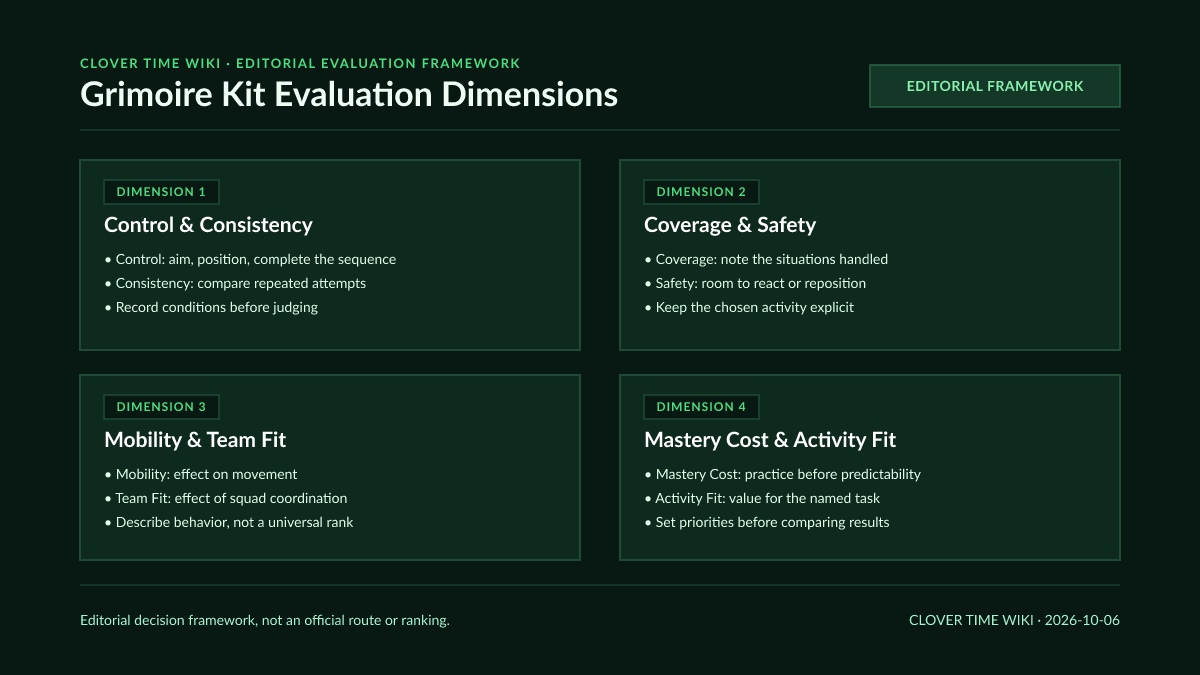
Use the same dimensions for each Grimoire you personally test:
- Control: how reliably you can aim, position, and complete the intended sequence.
- Consistency: whether repeated attempts produce similar practical outcomes.
- Coverage: how the available actions handle one target, moving targets, or space around you.
- Safety: how often the sequence leaves room to react, reposition, or recover.
- Mobility: whether using the kit helps or complicates movement during the chosen activity.
- Team fit: what changes when squad members create openings or need support.
- Mastery burden: how much practice you need before the kit behaves predictably in your hands.
- Activity fit: whether those traits help with the exact task named at the start of the test.
These dimensions are deliberately descriptive. They do not assume an official formula, hidden coefficient, or fixed priority. A player who values simple execution may weigh consistency heavily; a coordinated squad may care more about coverage or team fit. Write down those priorities before comparing results so the conclusion follows the goal instead of changing after you see the outcome.
For useful notes, hold the test conditions steady. Use the same activity, comparable targets, the same equipment and progression state where the game permits it, and enough repeated attempts to notice whether an observation is stable. Change only one major factor at a time. If progression or an update changes during testing, begin a new record rather than blending incompatible observations.
The gallery testing template is designed for this discipline: record context, observations, uncertainty, and the next question. It is not a scorecard supplied by the developers. Its purpose is to make your own reasoning inspectable and to prevent one unusually smooth or frustrating attempt from becoming a sweeping claim.
Should you keep your current Grimoire or change it?
A keep-or-change decision should begin with a concrete problem, not a rumor. “I cannot reliably complete my current combat sequence in the activity I play” is testable. “Someone called another option stronger” is not enough, because it does not identify comparable conditions, your execution, or the result you are trying to improve.
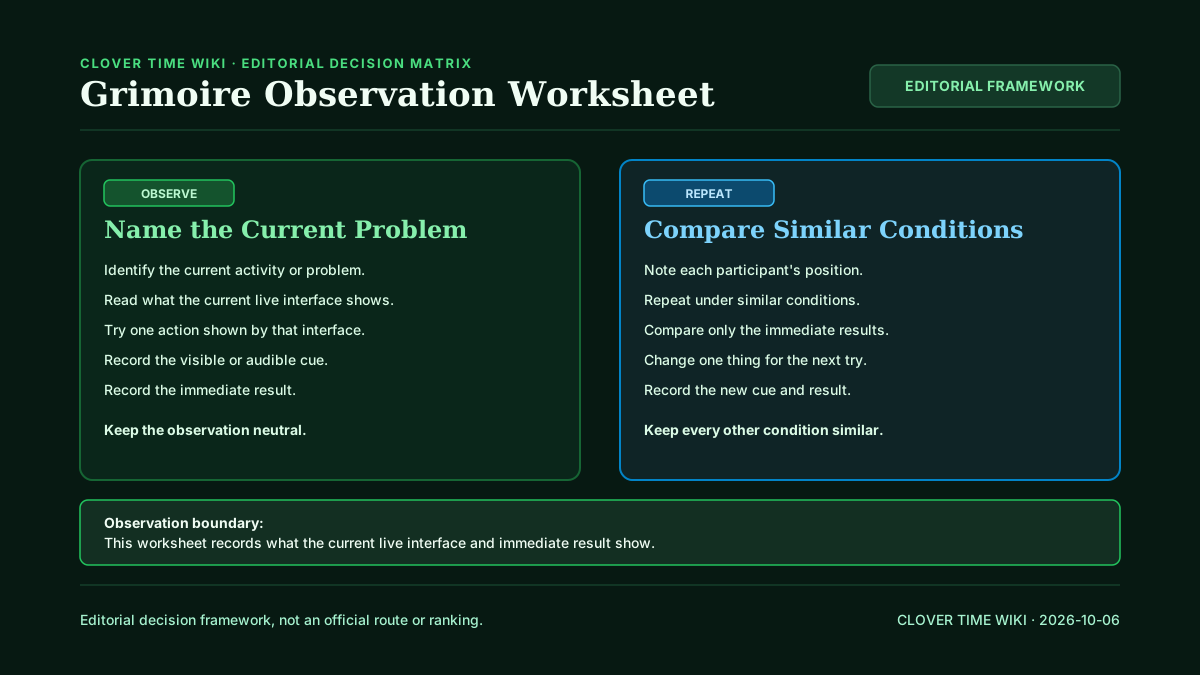
Complete this worksheet before choosing whether to keep the current Grimoire or, if the current live game offers a way to change the current Grimoire, use that option:
- Name the activity. State where the current kit is helping or blocking progress.
- Describe the failure. Record what happens without assigning the cause too early.
- Practice one adjustment. Test positioning, timing, or sequence execution before blaming the Grimoire.
- Check the current live game. Do not assume that a change option exists or how it works; rely only on what the current game shows.
- State the trade-off. If a change option is shown, write what known capability you may give up and what improvement you hope to observe.
- Choose deliberately. Keep the current kit when the problem is still unclear. Consider a shown change option only after reading its current terms and accepting the uncertainty it presents.
Keeping is not a declaration that a Grimoire outranks another. It can simply mean your current kit works for today’s activity, you are still learning it, or the available evidence does not justify a change. Choosing a change option, if one is currently offered, is likewise not proof that the previous kit was weak. Record the reason either way so you can review whether the decision solved the stated problem.
New players should first use the beginner guide to separate learning problems from resource decisions. Players preparing for group encounters can use the Boss guide to build an observation plan without assuming that one Grimoire solves every encounter.
What evidence is still missing?
Four major gaps prevent a defensible universal ranking. The current public source set does not provide a complete official rarity framework for all ten entries, a complete roll-probability table, comparable damage data gathered under one method, or a universal ordering that applies across activities and player contexts.
| Evidence gap | What would be needed before publication | Current editorial response |
|---|---|---|
| Rarity | A current official classification covering every roster entry | Do not infer categories from names, effects, or community graphics |
| Roll probability | A current official probability table with scope and version | Do not turn anecdotes or small personal samples into public rates |
| Damage | Comparable official data or controlled, reproducible tests for every entry | Describe observed behavior without publishing unsupported values |
| Universal ranking | A declared use case, consistent criteria, and comparable evidence across all ten | Publish the roster and decision method instead of a power order |
An evidence gap means “not established by the sources used here,” not “impossible to know” and not “all options are identical.” Future official documentation or careful repeatable testing could support narrower comparisons. Any such update should name its scope and date, preserve the official roster spellings, and avoid presenting one activity-specific result as a rule for every player.
Because Clover Time describes itself as a changing beta, observations can age quickly. Recheck the live game and official sources after updates, keep old and new test records separate, and treat disagreement as a reason to inspect conditions rather than force a single answer. The FAQ links the official channels used for update checks, and the codes page shows the same cautious treatment of volatile information.
Sources
- Official Clover Time Trello board, including its Grimoires list, accessed October 6, 2026.
- Official Clover Time Roblox page, accessed October 6, 2026.
- Roblox games API for universe 9891331827, accessed October 6, 2026.
- Original diagrams were created by Clover Time Wiki for this guide.
Gallery
Related Articles
beginner-guide
Clover Time Beginner Guide
Start Clover Time with a source-backed plan for Grimoires, spells, broom travel, squads, bosses, and AFK rewards without invented mechanics.
codes
Clover Time Codes (October 2026) — Active Rewards
All active Clover Time codes on Roblox for free spins, reset stats, and chests. Sourced from the official Trello with verified redemption steps.
boss-guide
Clover Time Boss Guide and Verified Roster
Prepare for Clover Time bosses with the official seven-boss roster, verified Salik data, and a safe strategy framework without fake drops.
Was this helpful?
Thanks for the feedback!