Clover Time Beginner Guide
Start Clover Time with a source-backed plan for Grimoires, spells, broom travel, squads, bosses, and AFK rewards without invented mechanics.

Know Which Game You Are Opening
Clover Time is the Roblox experience named Clover Time [BETA RELEASE], using place ID 93934100402512 and universe ID 9891331827. Roblox identifies AnimeCore Studio, group ID 175661976, as its creator. Use the official Roblox experience page as your starting point so that a similar title, copied link, or old bookmark does not send you somewhere else.
The official description currently lists Mobile, PC, and Console support. It also calls the game a beta that is constantly changing and improving. That combination matters: you can choose the supported device that suits you, but screenshots, route advice, and interface instructions may become stale as the beta changes.
Use a First-Session Checklist
Your first session should answer simple questions before you make larger decisions. The aim is not to finish everything. The aim is to understand what your current controls, spells, and movement communicate clearly enough that later choices are based on your own play rather than an unsupported ranking.
- Confirm that you opened the official experience and note which supported platform you are using.
- Learn the controls shown by the current game and test basic movement in a low-pressure moment.
- Read the spell information the game gives you before trying to combine inputs quickly.
- Practice one repeatable sequence, then observe what you can and cannot execute consistently.
- Record one question for your next session instead of changing several things at once.
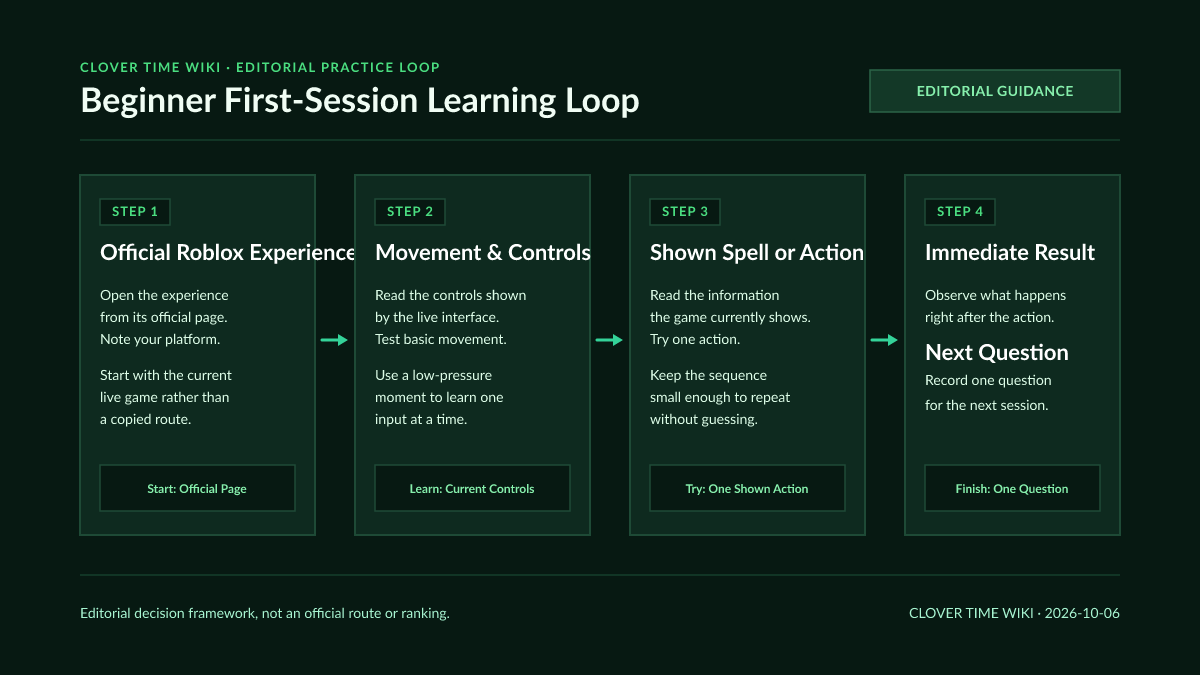
This order is deliberately modest. A short loop of practice, observation, and one adjustment makes it easier to tell whether a problem comes from unfamiliar controls, an unclear spell sequence, or a decision you have not yet understood. Changing everything together hides that information.
Make the First Grimoire Decision Carefully
The official description says players roll and master Grimoires and highlights spells, spell combos, and awakenings. It gives Anti-Magic, Battle Lightning, and Flame as examples, but those examples do not establish a complete ranking, rarity table, or set of roll probabilities.
Treat your first Grimoire as a learning tool, not as proof that your account is good or bad. Before considering a replacement, spend enough active play to understand whether you can use its spells deliberately. A name that appears in a video or community list is not, by itself, evidence that changing will improve your first-session experience.
Ask these questions in order:
- Can I describe what my current spells are meant to let me try?
- Can I execute a simple sequence consistently enough to evaluate it?
- Is my frustration about the Grimoire, or am I still learning controls and timing?
- Do I have a current, primary source for any claimed cost, probability, or guaranteed result attached to changing it?
- If that evidence is absent, can I postpone the decision and keep learning instead?
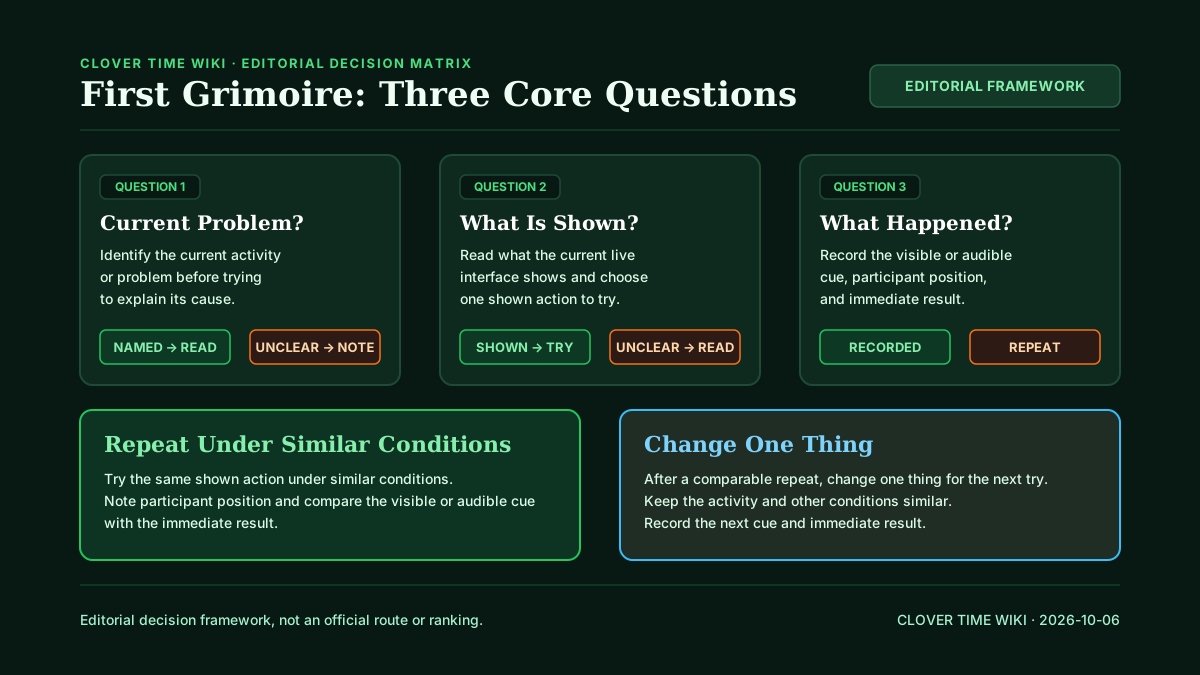
The Grimoire guide is the next place to compare the verified roster with the limits of the available evidence. Use it to identify names and frame better questions, not to skip the work of learning the Grimoire already in front of you.
Understand the Spell and Broom Boundaries
Spells, spell combos, and awakenings are all features named in the official description. That confirms the broad combat vocabulary, but it does not make every community combo, timing claim, damage number, or awakening route official. When testing, describe only what you can reproduce in the current game and keep unverified numbers out of your conclusions.
A useful practice routine is to choose one spell sequence, attempt it several times under similar conditions, and change only one part when it fails. This is editorial training advice rather than a hidden mechanic. Its value is that it produces clearer observations than switching spells, inputs, and goals after every attempt.
The official description also lists Magic Broom flight and world exploration. It does not establish a permanent route map, travel speed, unlock cost, or exact destination list in the evidence ledger. Because the experience describes itself as a changing beta, verify route-specific advice in the live game instead of assuming an old map remains exact.
Use broom travel as a learning pass: notice broad connections, revisit places the current interface points you toward, and avoid presenting your personal route as mandatory. The safe conclusion is that broom flight and exploration exist; the efficient route for every player is not established here.
Prepare Before Joining a Squad or Boss Attempt
The official description says Magic Squads can team up to defeat bosses. It does not, by that statement alone, verify a required squad composition, recommended level, universal boss mechanic, location, weakness, resistance, reward, or drop rate.
Before a first boss attempt, use preparation that does not depend on invented details:
- Practice a short spell sequence you can repeat without guessing at the inputs.
- Ask the squad what plan it wants to try and repeat your understanding back clearly.
- Agree on a simple regroup signal before the attempt begins.
- Observe the encounter before making claims about patterns or counters.
- After a failure, change one decision and compare the next attempt rather than replacing the whole plan.
Your first goal is reliable participation, not proving that you know a secret strategy. Clear communication and limited changes make each attempt easier to evaluate. If another player gives an exact weakness, location, reward, or drop rate, ask for a current official source before this wiki treats it as fact.
The Boss guide records the verified roster and labels the remaining evidence gaps. Read it before turning a named encounter into a detailed plan, because a verified boss name does not automatically verify everything said about that boss.
Use AFK Rewards Without Taking Account Risks
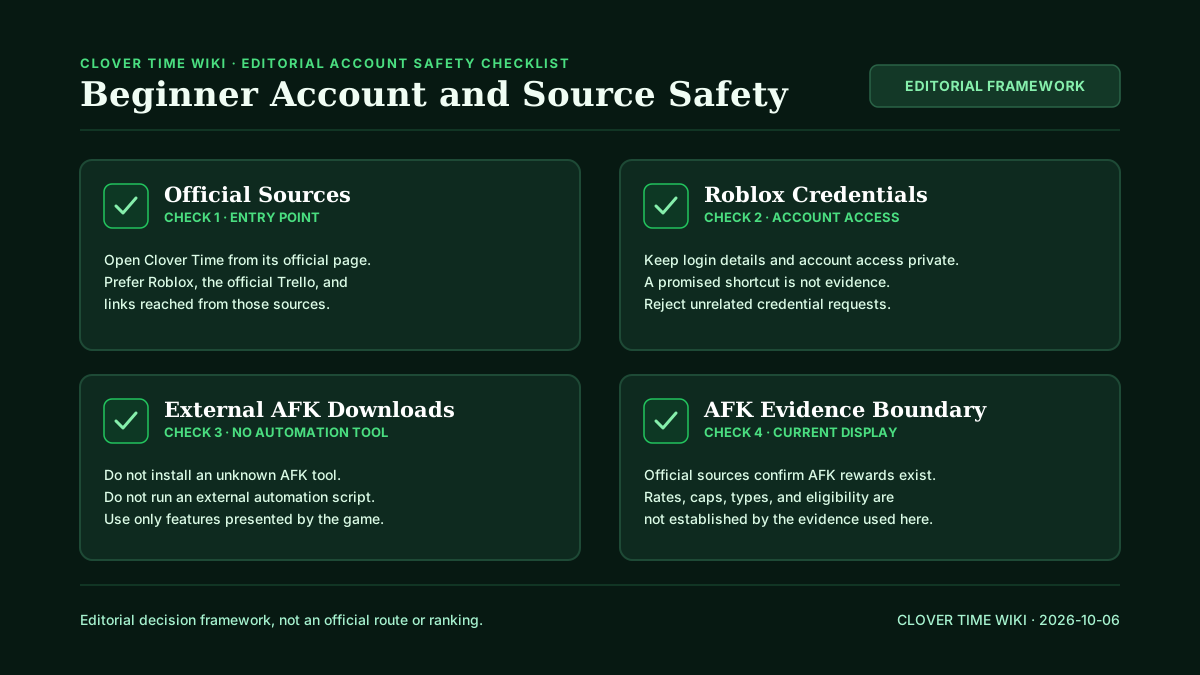
The official description advertises an AFK World that grants rewards while resting. The public evidence does not state reward rates, caps, reward types, or eligibility rules. Check the rules presented by the current game before relying on a particular outcome or deciding how long to remain there.
AFK convenience is not a reason to install an external automation tool, run an unknown script, or disclose Roblox credentials. This guide does not endorse a workaround for unattended play. Use only the experience’s own presented features, keep account access private, and leave the session if a request or download feels unrelated to normal play.
Avoid Common Beginner Mistakes
Mistake: treating a feature mention as a full instruction manual. The official description confirms Grimoires, spells, awakenings, broom travel, squads, bosses, and AFK rewards, but each confirmation is narrow. It does not silently verify community costs, rates, routes, rankings, or encounter details.
Mistake: changing several decisions after one bad attempt. If you replace the sequence, goal, and group plan together, you cannot tell which change mattered. Keep one stable baseline, adjust one choice, and observe again.
Mistake: using a fixed guide as if the beta cannot change. The developer describes Clover Time as constantly changing and improving. Recheck volatile advice against the official experience and current official material, especially when a claim depends on an exact interface, route, or number.
Mistake: confusing confidence with evidence. A polished tier list or precise percentage can still be unsupported. For Grimoires, the current evidence does not establish complete universal rarity rates, roll probabilities, comparable damage values, or a universal S-to-D power ranking.
Choose the Next Useful Link
If your next decision is about keeping or replacing a Grimoire, continue to the Grimoire guide. If you are preparing to join a group encounter, use the Boss guide. Both pages distinguish verified source material from editorial decision tools.
For official community destinations and the site’s update policy, open the FAQ. For code candidates listed by the developer, use the codes page and check its freshness notes rather than assuming every copied code remains current.
The best next step is the one that resolves your current uncertainty. Keep the practice loop small: verify the source, try one understandable action, observe the result, and adjust one decision. That produces useful progress without pretending the game has published an official optimal route.
Sources
- Official Clover Time Roblox page, accessed October 6, 2026.
- Roblox games API for universe 9891331827, accessed October 6, 2026.
- Official Clover Time Trello, accessed October 6, 2026.
- Original diagrams were created by Clover Time Wiki for this guide.
Gallery
Related Articles
codes
Clover Time Codes (October 2026) — Active Rewards
All active Clover Time codes on Roblox for free spins, reset stats, and chests. Sourced from the official Trello with verified redemption steps.
boss-guide
Clover Time Boss Guide and Verified Roster
Prepare for Clover Time bosses with the official seven-boss roster, verified Salik data, and a safe strategy framework without fake drops.
grimoire-tier-list
Clover Time Grimoire Tier List and Roster
See the verified Clover Time Grimoire roster, what official sources actually confirm, and why unsupported rarity or power rankings are excluded.
Was this helpful?
Thanks for the feedback!